
Double - Sided History

It's been a long time coming, but a very special restoration project has just been completed at the Bakke Coffee Museum, and we're so excited to share it with you!
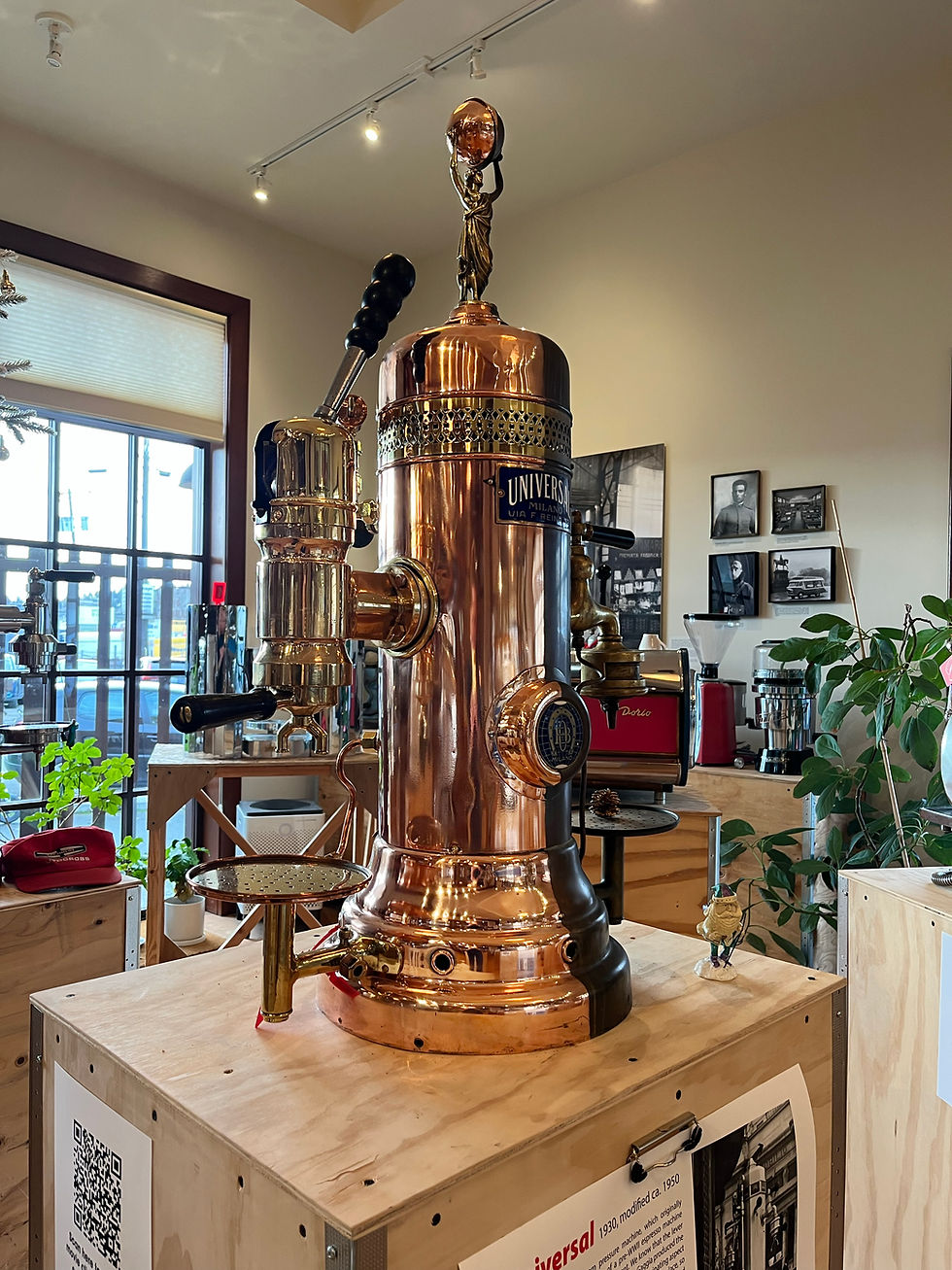
This machine was incredibly unique to begin with — a rare example of a pre-WWII two-group vertical steam pressure machine with a lever attachment added at some point. (Presumably shortly after the lever was introduced by Achille Gaggia in ca. 1948.) The other original group, which used steam pressure from the boiler to force the hot water through the ground coffee, was left in place. The combination of old and new displayed in this Universal espresso machine, which was manufactured in 1930, makes this an very curious artifact of espresso history. And once we started looking deeper, things just got curiouser and curiouser...
As you may already know, the invention of the lever was a revolution in the history of espresso. The steam pressure machines that were common until just after WWII were only using around 2 bars of pressure or less, and the coffee they produced was closer to that from a moka-pot than that of a modern espresso machine. The new lever group-head, with a giant coiled spring inside, was able to reach the 9 bars of pressure that is still the standard today. A pretty substantial difference!
The lever is what brought about the intense espresso extraction topped with rich crema that we adore today. After Gaggia began producing and selling lever machines, other espresso machine companies quickly followed suit. Many cafes replaced their old steam pressure models with new lever models that proudly proclaimed "crema caffè naturale" and "funzione senza vapore", advertising that they were extracting the coffee without the use of steam. But for a short time, it was also possible to buy just the lever group and attach it to an old machine. This might have been done to save money, but another possibility was that some cafe owners wanted to offer both styles of espresso, old and new. Because people's tastes don't always change immediately, and some customers still preferred the steam pressure espresso they were accustomed to over the new "crema caffè".
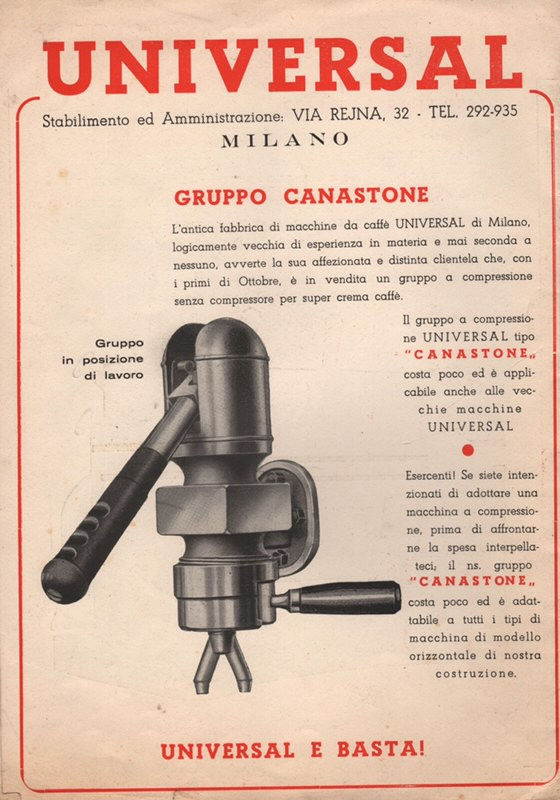
We will never know exactly why this particular Universal ended up with a lever attached, but we are grateful to have it as part of the Bakke Collection. The machine represents a unique point in the history of espresso when one era was rapidly being overtaken by another. For a long time it has been an important talking point on our tours, helping explain the evolution of espresso. Then one day Kent wondered what it would look like if we restored half of it, so that it would be an example of old and new in more ways than one...
So we dove in! And almost immediately, found more mysteries and challenges. Our master machinist and espresso machine restorer, Lars, quickly realized that at some point someone had taken the machine apart and not put it back together correctly. But we had no similar example of a Universal from that era to compare it to. Fortunately, we were able to find enough photographs of comparable machines as well as old advertisements from the company to reconstruct the machine as it was intended. After that, we were able to take inventory of what was missing... Some parts needed to be replaced, some needed to be repaired and cleaned up. Getting the machine back to working order was a tedious puzzle, but eventually we were ready to test it for leaks, and see what kind of coffee came out.

Immediately we faced another problem — this machine was heated by gas. So far, all of the machines we have restored at the museum have been electric or converted to electric at some point in time. In order to test this Universal, and find out what kind of coffee it made, we had to light a flame on the old gas heating element. So, we hooked it up to a propane tank (outside!). It was very difficult to get it sufficiently hot. This was partly due to wind, and also because in the old days of espresso in Europe they were probably using a different fuel, like butane. But eventually it was it hot enough to pull some shots on both the traditional and the lever group. (Although there were still some renegade leaks).
After all that effort, we will probably not be making coffee on the Universal again anytime soon. But the exterior restoration realizing Kent's idea that the machine be half-way restored in order to showcase old and new has been a success, and the results are stunning! It's hard to imagine, but according to Lars, the polishing was the easy part of this project... Come by the museum and see for yourself!



Comments